Thermal Cameras:
Go Beyond Security
Explore new applications in healthcare, manufacturing and more


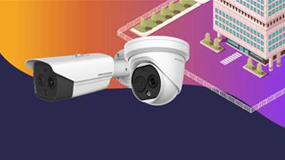
Thermal cameras, traditionally known for their role in security and surveillance, are undergoing a transformation. As technology evolves, these devices have become more accessible, more versatile and more integrated with advancements like artificial intelligence (AI) and the Internet of Things (IoT).
During a recent conversation with Nathan Vaughn, a thought leader in the thermal camera category and a senior technical sales specialist with ADI Global, he shared his thoughts on evolving needs and opportunities. According to Vaughn, he perceives a significant opportunity for expanding the applications of thermal imaging. As he puts it, “I think there's a lot of areas in which people aren't using them advantageously, or some areas in the markets where we could be see more use.” Vaughn believes that the underutilization of thermal cameras in many sectors could be addressed through better education and higher awareness among integrators and end users.
Underlining the point, Vaughn emphasizes that exploring innovative applications for thermal imaging and identifying key market areas where greater adoption is possible could lead to increased efficiency, safety and new business opportunities.
Before turning to possible new uses, let’s review some current uses of thermal imaging cameras and how they add value. At this time, thermal cameras are most commonly used in security systems, artificial intelligence, healthcare and end user applications.
The best-known application for thermal imaging cameras lies in security. Thermal cameras can be placed outdoors and cover the surveillance of huge areas, all with no user monitoring required. They can detect individuals in areas where they should not be, with results immediately interpreted by the system and security personnel alerted to follow up. They have the ability to determine inappropriate actions regardless of lighting conditions, weather conditions or the attention/focus of an operator.
One area seeing a surge in thermal camera adoption is perimeter security for large open spaces such as car lots and parking areas. “We’re seeing a lot of [interest in this technology among] people trying to watch large areas,” Vaughn explains. “There's been a rampant increase in catalytic converter thefts. So, car lots, parking lots — you know, some huge areas — where people are trying to watch the perimeter and watch people come in. And so, they’re using a number of different traditional cameras, zoomed in.” However, Vaughn says, these users are encountering distance limitations on the infrared range or the white light range. “You don't have any of those limitations if you're using thermal,” Vaughn declares, “and you're reducing the camera count substantially.”
Another advantage of thermal imaging is its resilience to environmental factors, making the technology suitable for protecting large-scale outdoor facilities for which maintaining constant, reliable monitoring is essential. As Vaughn puts it, “You could couple [all those benefits with] the fact that thermal cameras are not impacted by the weather.”
In addition to basic security use, artificial intelligence is transforming surveillance tools like thermal cameras by providing smarter detection capabilities. Vaughn is highly knowledgeable about this and explains, "Some manufacturers have it included on the camera. [For] some, it's add-on; [for] some, it's third party. But anytime you can add additional details, in the security world, [it] is beneficial." AI tools can detect and classify objects, determining whether something is a person or a vehicle, as well as much more. “[Being able to] determine direction, determine if it's crossing into a land or determining if it's loitering — all that's beneficial,” Vaughn says.
Vaughn elaborates further, detailing a potential scenario: "If you have someone walking down a fence line, going from A to B, and they're just walking to their destination, it's not a big deal. If you have someone walking down a fence line, and they stop for 30 seconds and go into the trees, then that all of a sudden becomes a big deal. And you want to know about that. And so, you want to have rule sets, and AI can do that.”
Vaughn continues on this point, saying, “[Suppose] you have a guard on station, for example, and you don't want him to be live monitoring videos for multiple cameras all the time. [Instead,] you want him out patrolling. You could [let] AI notify him of a person in an area doing something that was not allowed, and he could report to the area.”
We’ve also seen thermal imaging step up in multiple healthcare applications, especially in recent years. Vaughn’s knowledge of this shines through as he recounts pandemic-era applications. “COVID-19 was an excellent example,” he says. “There [were] estimated body temperature cameras that we would have [set up] in hallways.” The instruments would be positioned behind individuals walking through the area, measuring people’s temperature plus or minus one-and-a-half degrees. “And so,” Vaughn continues, “as people walked through a hallway, you could scan, you know, 30 people at one time. And then, if you found anyone that set up an alarm, [they] would be handed off to an individual who would then check the temperature with an FDA-approved type device.”
This rapid and effective deployment helped offices stay open safely throughout the pandemic.
For property owners with expansive plots of land might also benefit from thermal imaging technologies. “The only time we've used thermal cameras on the consumer market would be for large properties,” Vaughn affirms. “So, people [who] have farms, acreage, wood, tree lines — you know, wooded properties.” He continues, “[There are] more calls than you would think [involving] people wanting to know if there was deer in their backyard. So, that's a great use case: Put a camera on top of a home, look into 20 acres and be able to see a large portion of that.”
Beyond just wildlife tracking, thermal cameras offer a cost-effective solution for monitoring large properties without disrupting the landscape or requiring extensive installation labor.
Vaughn points out extensions from existing applications into hypothetical future uses.
Thermal imaging plays a critical role in industrial settings, particularly for equipment monitoring and predictive maintenance. These cameras can detect overheating machinery, electrical faults and other potential disasters in waiting. Vaughn cites manufacturing warehouses, smelting plants and garbage dumps and says, “Where there is risk of, you know, decomposition causing fires, you can set these to kind of be pre-combustion temperatures or pre-failure temperatures. So, you can be proactive in that response.”

Available Now |
Monitoring server room temperatures for network reliability |
Available Now |
Detecting pre-combustion temperatures in smelting plants |

Speculative future use |
Full integration with IoT systems and drones for automated industrial safety responses |
Speculative future use |
Predictive maintenance systems linked to real-time supply-chain adjustments |
Thermal cameras have proven invaluable for firefighting, allowing responders to locate victims in smoke-filled environments and identify hotspots in real time. This technology enhances many disaster response strategies. They have helped with locating survivors under rubble or monitoring heat signatures during large-scale emergencies.
Available Now |
Locating victims and identifying fire hotspots in firefighting |
Available Now |
Monitoring crowd density during public events |
Speculative future use |
Advanced systems to monitor entire cities for disaster preparedness |
Speculative future use |
Real-time evacuation guidance systems based on thermal imaging |
Thermal cameras are becoming increasingly accessible to everyday consumers. Handheld versions can enable users to detect energy loss in homes, identify plumbing leaks and observe wildlife. Consumer-friendly innovations like wearable thermal technology will drive further advancements in thermal imaging and expand its applications beyond professional use.
David Danto, a longtime industry analyst who attended CES 2025, echoes this opinion. He says, “We are seeing a huge emergence of wearable and miniaturized technology, and applications for the kind of sensors that have been used in business for years. These new applications will open up whole new markets for existing technology used in new and exciting consumer applications.”
Available Now |
Devices for home energy diagnostics |
Available Now |
Wildlife observation tools for enthusiasts |
Speculative future use |
Wearable thermal imaging devices for personal safety and health monitoring |
Speculative future use |
Integration with home automation systems for real-time temperature management |
Despite their versatility, thermal cameras face adoption barriers. Advanced systems can be expensive, and interpreting thermal data requires skilled operators. Vaughn pointed out that privacy concerns, particularly in healthcare settings, require thoughtful and earnest consideration. As Vaughn puts it, “I don't think most people would feel great about having cameras monitoring them, 24/7, in their room.”
However, as prices drop and interfaces improve, these barriers may diminish. Vaughn believes that security integrators should consider how addressing these challenges proactively could set their organizations apart as an innovator in the field. Collaborating with technology providers to simplify user interfaces could open the market for a wider range of end users.
Danto echoes that sentiment. “There are three classes of applications: what is in use today, what could easily be meeting needs in the near future simply by better utilizing today’s technology and devices, and what will require technological adaptation for future applications,” he says. “We could all wait and watch for future-oriented development, or [a larger number of] sharper firms can take what is available now and apply it innovatively to meet today’s emerging needs.”
For integrators, the expanding applications of thermal imaging certainly present an opportunity to deliver innovative solutions across industries. Vaughn believes in the imperative to educate clients about the benefits and possibilities of thermal cameras.
- Nathan Vaughn, senior technical sales specialist with ADI Global
Vaughn continues, “Plus, it can also help your customers be proactive on equipment failure or maintenance. And those [features make it a technology that] can't be matched by anything else.”
Thus, savvy integrators should consider how leveraging thermal cameras can enhance safety, efficiency and sustainability in multiple client operations. Meanwhile, for end users, understanding the potential of thermal cameras could help identify areas for improvement or innovation.
Thermal cameras have evolved far beyond their origins in security and surveillance. With advancements in AI and decreasing costs, these devices are transforming industries. As everyone explores these innovative applications, we need to consider how thermal imaging could pave the way for a more efficient, more capable future.